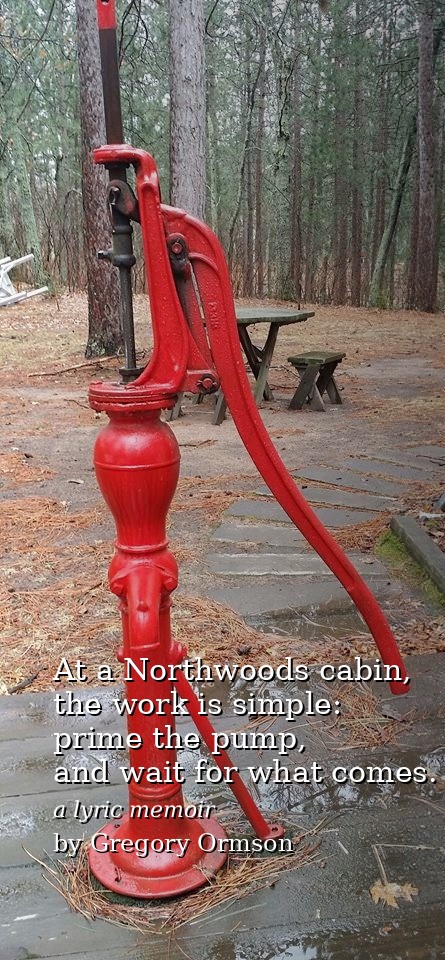
Stories Emerge Like Bears is a lyric memoir by Gregory Ormson, set in a Northwoods cabin where attention, labor, and place shape a life lived at human speed.
At the cabin, if you want water, you draw it by hand from a pump just outside the door. But the pump does not work immediately. Before clear water rises, it must be primed.
Going to the cabin meant that I had to carry water in a thermos or jug and pour a small amount into the top while working the handle. The pump squeaks at first. Then, slowly, the sound changes, and with it comes cool, clear, northern Wisconsin water from below.
What does it mean to “prime the pump”?
To prime the pump means preparing the conditions for something to emerge rather than forcing it through effort alone.
You cannot force the water. Effort alone does nothing. You prepare the conditions, and then, while working the handle, you wait for what rises. Too much force breaks the system. Pump too hard and the gasket blows.
The lesson is restraint. The lesson is sequence. The lesson is trust in what lies beneath.
Why can’t you force the pump?
Because the system depends on care and preparation, not pressure.
Prime the Pump
The pump does not respond to high pressure. In fact, with too much force, it can blow a gasket and stop working. The pump responds to care and practice. The hand works the handle steady and true, and the water comes from below.
There is a relationship between effort and yield vs. control or force. It is the energy behind extraction by force vs. emergence by invitation.
What did the pump teach about teaching and speaking?
Learning cannot be forced; it must be drawn out through preparation, patience, and trust.
Through that trust, built over time, I began to see the red-handled pump as instruction. It is the same principle applied in the classroom. There is no bailout. The pump must be primed.
If I wanted anything from my students, I had to prepare the conditions for them to speak, to think, to respond. At first, they resisted. They squeaked and complained. They stayed hidden. They did not bite, but they snarled and snapped at the edges of the work.
Why do people resist being “drawn out”?
Because it is easier to wait for someone else to do the work that must come from within.
I saw it in my students. They were like Dorothy and her companions on the yellow brick road, looking for a wizard to solve their problems. They believed someone else could supply what had to come from within.
They insisted I could help them, but I resisted that role.
What is the lesson of the pump?
No one else can do the work of emergence for you.
The curriculum disclosed the wizard’s secret. It is smoke and mirrors. There is no external force that will make it all better.
Some students resisted this. Some became angry. And some, like Dorothy, woke up.
This waking started the change.
What did you notice here? I welcome your thoughts.