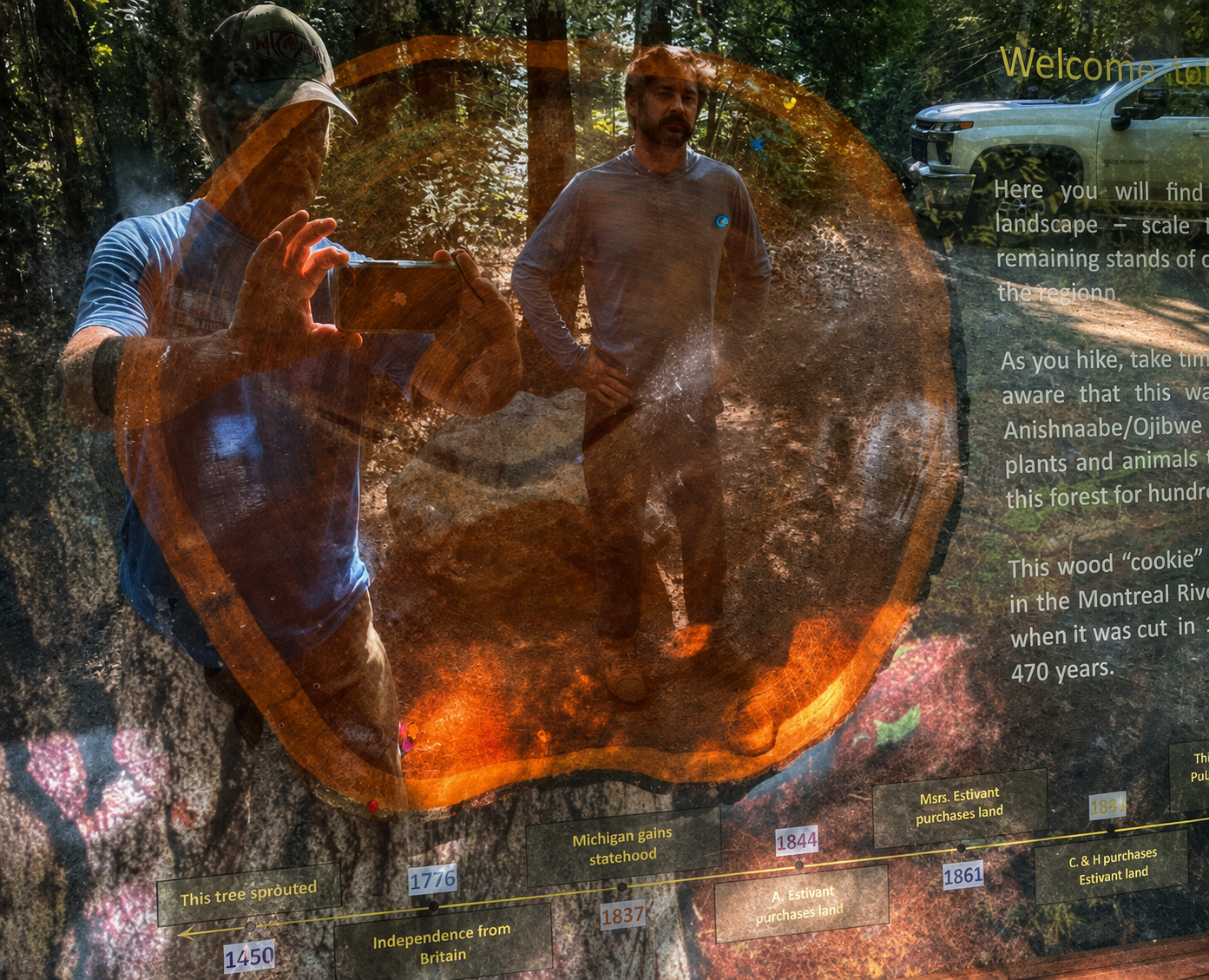
When my friend Mary Bonner from the Upper Peninsula Peace Group mentioned that she was going to the Estivant Pines near Copper Harbor, Michigan, I asked what it was. “It’s an old-growth sanctuary of giant white pines and other hardwoods, she said, “some of them nearly five centuries old and over 100 feet.” Over the years, I tried getting there but never made it.
I finally visited the Estivant Pines Nature Sanctuary in August. The 2020 U.S. Census lists Copper Harbor as having 136 permanent residents. It’s on the western and northern edge of Michigan’s Upper Peninsula, and is called the Keweenaw Peninsula, a sliver of land jutting eastward into Lake Superior. It’s as far north in Michigan as anyone can go by vehicle, and it’s a bit like Mars, not -80º degrees Fahrenheit, but still cold as hell.
My son Desmond lives there building mountain-bike trails. Spending days in the woods, he walks up and down to measure the rise and fall of the trail, building jumps and curves, calculating grades and drainage, and becoming one with the Keweenaw’s difficult terrain
He designs how a trail should rise, fall, and curve through rock and forest. When a trail section nears its completion, he jumps on his bike to test the trail’s feel and adventure quotient. “Trail building,” he said, “is physically taxing, but mentally taxing too.” I listened while my son interpreted the path of his serpentine-like, high-adventure mountain bike trail.
Father and Son Among the Estivant Pines
The next day he took me to the Estivant Pines Nature Sanctuary. On the way there, I wondered aloud how the trees survived the aggressive logging of the last two centuries. Somehow, a 570.5-acre stand of giant eastern white pines escaped the saws, axes, horses, railroads, and machinery that removed so much of the old-growth woods. Desmond didn’t need long. “Probably the terrain,” he said. He was right, but logging history is more complicated, of course.

Photo courtesy of the Marathon County Historical Society, photographer not identified. Marathon County in Wisconsin is not the same as Keweenaw County in Michigan, yet they share a similar logging history. Originally, pines were favored as they floated better on the rivers. When the railroads came in during the last 20 years of the 19th Century, it made cross-country transportation of the old pines and hardwoods more efficient and the loggers could then travel farther into the forest for big lots. On top of this skeleton car, a stripped-down railroad car, most likely on a temporary track. Teams of draft horses then transported logs from the temporary track to the permanent track.
# # #
The Estivant property, originally a 2,400-acre tract owned by Parisian Edward Estivant, passed through private and corporate ownership before the Michigan Nature Association began acquiring and protecting the surviving old-growth forest in the 1970s. People became the second step to preserving the remaining 500 acres, but the difficult ground itself had been the original guardian.
We arrived, parked at the trailhead, and took the Bertha Daubendiek Memorial Grove Trail. Desmond knew where he was going. At first, I sensed that he was there mostly because I had asked him to take me. Estivant Pines was my destination, the place his father wanted to see.
Along the way he stopped and identified a plant and mentioned its medicinal use by Native Americans. He pointed out differences among trees. His eyes were working like a trail builder, seeing the possibilities.
Then we reached the Cathedral Loop Trail and that’s when his step quickened. “That’s where we’ll see the big ones,” he said. Moving ahead of me, he suddenly stopped, looked off the trail, and headed down a steep bank.
“Here’s a monster.”
I followed to a giant white pine rising out of the ground and disappearing upward. He went to one side of the trunk, and I went to the other. We wanted to see whether together we could reach around it and join hands. Father and son. Four arms.
We stretched and our hands made it perhaps three-quarters of the way around, measuring a tree while the wooden rings of time measured us. I put my hands against the bark. Desmond put his hands against it too.
I don’t know what he felt or thought, but I don’t need to make his experience identical to mine. I know what I felt when I touched the grandfather: the large eastern white pine, Pinus strobus, known by its five soft needles gathered in a bundle and its deep-furrowed bark and long slender cones.
I’m a grandfather now too, but my grandfatherhood will occupy a small portion of time. Some white pine grandfathers have been there a long time, beginning as seedlings nearly five centuries ago. One tree-ring display at the Estivant Sanctuary traces the life of a pine back about 470 years to a seedling before it emerged from the ground around 1450.
Think of that seed opening to the sun as history unfolded around it; before Wisconsin, MIchigan, or even The United States had names, before my ancestors had imagined coming here.
We touched that history in the bark, feeling its heft, its weight, its gravity. Much like the love between fathers and sons or mothers and daughters, immigrant journeys, and the battles between sanctuary and sawmill, survival is precarious.
In 1848–49, another kind of seed began its germination when the idea of Wisconsin took hold in my great-great-grandfather living in Norway. He, along with his wife and small children, took a risk, and jumped a wooden boat in November 1948 to sail across the Atlantic, arriving in eastern Canada in February 1849. That journey brought my blood from Norway to the new state of Wisconsin, established the previous year in 1848.
I wasn’t thinking of this at the time as my son led me around the Estivant Pines’ Cathedral Loop where we came to an enormous eastern white pine. “Look how straight it is,” he said, looking upward.
He walks the earth, planning how to turn the terrain’s irregularities and curves into challenging trails, but in that moment, the curve whisperer stood beneath and noticed one magnificent straight line.
When we put our hands on the tree, there wasn’t much talk. In the Sanctuary of Pines, words were just noise, but the birds were talking and that was enough. Standing there with my grown son, I thought of the pathos in Cat Stevens’s song, “Father and Son.” There is love between them, but they cannot fully inhabit one another’s worlds. A poignant departure is built into the relationship. But for a moment, before any departure, they stood together on the Cathedral Loop beneath the massive pine and looked up.
One reality of the generations is that we do not get to keep standing with one another. Grandfather pine and Grandmother pine had for centuries watched many departures of sons and daughters, fathers and mothers. And now, in the brief interval where our paths crossed, they would observe us as we walked away. If we are aware, we marvel at the straight lines and the curves, and recognize the gifts given by observing.
The next day, I had to leave Copper Harbor, and I thought the Estivant Pine Sanctuary story ended there. We said goodbye, and I drove nearly six hours to my family cabin in northern Wisconsin. There, I began an inventory of the trees. It’s embarrassing to write that sentence as our family has had the cabin on that land for more than fifty years.
I had walked among the trees, cut wood beneath them, observed the harvest of hunting season when the deer were dangled by their antlers in oak, listened to wind move through them, raked their needles, listened to the acorns drop on the tin roof of the porch, watched the owls high in the red pines, watched the red maple leaves fall, photographed them, written beneath them, and looked past them thousands of times.
I knew we had trees . . . I did not know all their names.
After Estivant Pines, that suddenly seemed like an omission.
# # #
DENDROLOGY: THE OLD-STYLE PLACE

Red pine / Norway pine — Pinus resinosa
Long needles paired in twos. Tall, straight native pine of the northern forest. Wisconsin commonly calls it Norway pine, although it is native to North America.
Northern red oak — Quercus rubra
Pointed, bristle-tipped lobes and shallow-capped acorns. A tree that puts the next generation directly into your hand.
Red maple — Acer rubrum
Toothed, usually three- to five-lobed leaves. One of the adaptable maples of the northern woods.
Sugar maple — Acer saccharum
Broad five-lobed leaves and the familiar northern hardwood whose sap carries stored sweetness upward each spring.
Quaking aspen — Populus tremuloides
Rounded, finely toothed leaves on flattened stems. The leaves respond to movements of air barely perceptible to us.
Spruce — Picea sp.
Short needles attached singly to the twig. The species at the Old-Style Place still awaits certain identification.
Balsam fir — Abies balsamea
Flat, soft needles attached singly to the twig, with two pale bands beneath. A fragrant northern evergreen whose upright cones distinguish it from the hanging cones of spruce.
Paper birch — Betula papyrifera
Pale, peeling bark marked by horizontal lenticels and toothed leaves. A northern pioneer tree whose white bark makes it one of the most recognizable inhabitants of the Northwoods. Also, my father’s favorite tree.
I pulled branches toward me. I separated needles with my fingers. I photographed bark. I held leaves against my palm. I picked up an acorn and turned it over in my hand. I measured trunks. I found felled trees and counted rings going backward from
Cathedral to leaf,
Leaf to seed,
Seed to ancestry.
After the inventory came the inheritance of a new twist to story. It always happens that way, the cabin that we call The Old-Style Place, delivers what I need even when I don’t know what I need. I have written for years about growth and ancestry with The Old-Style Place at the center of it all while an entire community of growth stood outside the door. Then one identification stopped me. The large pines at The Old-Style Place are red pines.
These are also known as Norway pines.
Norway.
There was that word waiting in the woods.
The Norway pine did not make an ocean crossing. Pinus resinosa is native to North America. The name is one of those synchronicities that language reveals, and memoirs listen to these acausal connections. The Norway Pine crossed the Atlantic only as a name, my ancestors crossed as people.
When a root goes down, a stem rises.
Years pass
generations pass
the tree roots
To meet on Wisconsin ground.
I had gone north looking for white pine and come home to find Norway Pine, a migration that was like all migrations, filled with surprise on both trails, one sanctuary-loop to another. Trees accomplish migration in many ways: they travel by wind, water, highways, and songs. They travel in all directions, carrying their own names and languages. Like the seed, people cannot take their home ground with them but they disperse in every direction to set down new roots.
And suddenly the tree inventory began to feel like an inheritance inventory. What was here before me? What arrived? What survived? What grew? What disappeared? What can I identify? What have I inherited without knowing its name? What have I overlooked because I was too casual to notice?
I didn’t know precisely how old the largest Norway pine at the Old-Style Place is, so I wrapped a tape around one at the four-foot mark. It measured sixty-eight inches. I measured other felled trunks too and counted rings where I could.
Trees ignore human calendars. Light, soil, competition, fire, water, injury, and weather alter their growth. A wide wooden ring records one kind of year, one of good growth; a narrow ring records another. The tree I measured had lived through all the fat and fallow from its beginning, which I estimated to be between 1920 and 1950.
We live through similar changes too. Richard Powers begins The Overstory with Jørgen Hoel, a Norwegian immigrant who plants American chestnuts on an Iowa farm. Human generations gather beneath the tree and disappear. Families expand, technology changes, wars pass through history.
The chestnut registered these events differently, in bark, height, girth, and rings. Powers kept a bead on those trees and moved from human time toward tree time, interpreting biology through dendrology, from chronological event and chronos to depth and kairos.
He writes of time as “one spreading ring wrapped around another,” growing or fading based on the tree’s adjustment to climate; this is what I began reading when I went to The Old-Style Place and started naming trees. Dendrology was teaching me another grammar of time, the meaning of the dark divot in the tree ring or the dark mark in our bodies and souls.
Ancestry wants to know the story behind the story. Some of it is hidden on the blind side of the tree, but what we know is heard in the voice of time. If we are quiet, that voice speaks right from the center of the tree. It whispers to us of important dates, fires, droughts, measurements, and the hidden miles and years in growth records.
Son: Desmond, born March 17, 1989, Marquette, Michigan.
Father: Gregory, born September 23, 1954, Rice Lake, Wisconsin.
Voice for people and trees: Yusuf Islam (born Steven Demetre Georgiou, aka Cat Stevens), July 21, 1948, London, England.
Ancestor: Knut Ormson, born June 20, 1820, Suldal, Rogaland, Norway.
I move along the Cathedral Loop, singing with Cat Stevens. “Your still young, that’s your fault, there’s so much you have to know.” He sees me from another part of the trail, out front on a curve up the trail and replies, “If they were right, I’d agree, but it’s them they know not me.”
We want to get our arms all the way around trees, relationships, and other things, but we can’t. At Estivant Pines, four arms reached around grandfather, three-quarters of the way, father on one side, son on the other.
There is always a blind portion on the far side of the trunk, a meaningful cipher around the corner we can’t see. There are years preserved in wood grain that we cannot touch or enter, years of our ancestors that we cannot know, parts of our children’s lives where we cannot follow.
Mary Bonner planted the words Estivant Pines in me nearly forty years ago. For decades they remained buried like a seed underground. My great-great-grandfather carried another seed forward too when someone in Norway spoke the word Wisconsin. It was a new state, and land was available. Its motto was and is Forward!
And all the while, after that first big tree harvest in the 19th century, the Old-Style Place kept growing Norway Pines. Acorns fell. Pinecones opened, and seeds emerged. Maples sent their futures spinning into the air, and birch seeds were carried by wind. Like people, some landed where nothing happened, and others opened to newness like fathers and sons, mothers and daughters, carried by currents unseen.
Eventually, someone stands beneath what has grown and wonders where it came from. Perhaps stories do the same by remaining underground longer than we imagine. They wait years, decades, sometimes generations for the right disturbance, the right rain, the right opening in the canopy.
And then the trail bends; a son quickens his step, leaves the path and heads down a steep bank. His father follows him down into that Cathedral Loop where a monster awaits, and for a while, we stand together, knowing how we touched that long-lived bark.
| “Now there’s a way, and I know, that I have to go away, I know, I have to go.” Cat Stevens, “Father and Son,” Tea for the Tillerman (1970). |

What did you notice here? I welcome your thoughts.