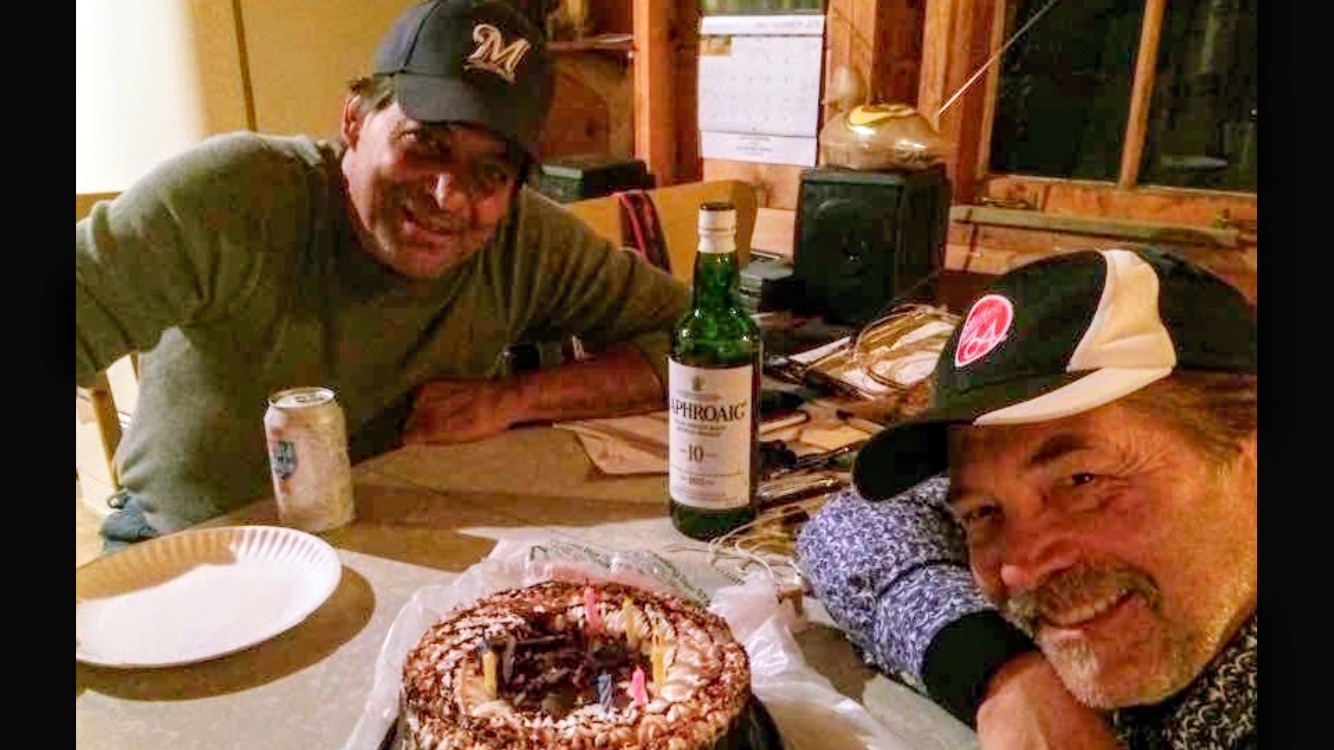
The Old-Style Place, September 23, 2016. Tim Ormson (left).
Holding What Remains
People go to Northwoods vacation properties for quiet and peace, but upon arriving, immediately turn on the noise makers: TVs, stereos, and phones. Whatever we meant it for, the Old-Style Place always delivered us from much of that, and gave us what we truly needed, even if we didn’t know it.
My brother Tim loved fishing and spending weekends at the Old-Style Place where he hooked, caught, and then fried up his fresh catches. Once when alone at the cabin, he noticed a Rapala, a Finnish casting lure with two treble hooks, laying on the floor of the boathouse. The Rapala’s hooks were caught in a loop of the carpet and this aggravated him, so he bent over to grab it and pull it out.
Tim had been a fine athlete when he was young, and was still strong through the shoulders and arms, but by his sixth decade he’d grown stiff and lost much of his flexibility. Back to the Rapala embedded in the boathouse carpet. He wanted to get it out, so he yanked but it didn’t budge. A second time, he yanked a little harder but the hooks stubbornly remained in the carpet.
That’s when he decided he’d force it and give it a hard, fast jerk. With a mighty pull, his fingers slipped, driving one or two of the sharp-barbed treble hooks deep into his palm near his thumb. Have you ever been hooked by a fishing lure deep in your skin. I mean really hooked, with the barbed points of a casting lure?
Hooked, bleeding, and in pain, he was stuck and it was a hot day. He was bent over in an uncomfortable position. Remember what I said about having grown stiff?
See yourself bend down to pick up something from the floor and then imagine a couple of sharp hooks with barbs stuck in your palm, near your thumb, literally hooking you like a fish. He couldn’t stand up. There was a knife on the table, but it was out of reach. Pliers and metal cutters were there too and so was his phone.
The hook was embedded deep in his bleeding palm. “I was all crunched up and couldn’t move. Sweating, and I thought I was going to die there,” he later told me. My brother had only one option, and that was to rip the hook out of his hand.
He knew it would hurt, but that’s what he did.
I’ve written about alone time at the cabin. It can be a rich time, but it can also be a dangerous time. If you fall and hit your head, or cut yourself, or have a heart attack, nobody’s there to help you. For years, I thought the story was mostly about Tim getting himself into a ridiculous predicament because he could not leave that lure alone.
Dislike it. Correct it. Force it. Get caught by it. Tim could have left that Rapala where it was. He didn’t leave it there, but leaving things alone is harder than we admit. We are caught in traps of our own making, hooked into a desire for convenience or comfort, hooked into consumption, hooked on the idea that nothing should be out of place and that everything can be improved, replaced, upgraded, moved, reconnected, automated, or made easier.
The world hooks us with a false need, so we carry things that hook us right into the places we go to escape them.

The Old-Style Place has resisted most of this; there is still no running water, and this little detail is only the tip of its resistance. The red handled water pump still squeaks. Fires still must be built when cold northern air comes through the walls. Wi-Fi does not serve the cabin. It has resisted improvement almost as stubbornly as that Rapala resisted Tim.
Over decades, the cabin has been teaching me a lesson: to accept what is enough and to leave alone what I have no business messing with. And maybe this is why I keep going back. The cabin does not hold things as important; it holds people as important. It’s about blood, not money.
My parents remain there in ways I cannot explain without sounding foolish. Tim is there. Others who sat at the table, slept in the bunks, carried wood, cleaned fish, laughed late into the night, and walked down the thirty-three steps to the lake remain there too.
Even small objects become a kind of roll call. I feast my eyes on one of them with my first step inside the front door. A Finnish fillet knife hangs on a nail to the left. It was given to me by a dear friend from college at UW–La Crosse, a woman who grew up in Finland. I see the knife and remember her before I ever touch it. The handle, the blade, and its leather sheath hold more than utility. They carry a face, a country, a love, another time in my life. That knife is more than just a knife. And when at the cabin, the memory enters my vision and time is changed. Then it becomes company, a living memory, simultaneously in the present and in the past.
This is what the cabin does to ordinary things. A pump becomes my father. A bowl becomes a hand that once held it. A fishing lure becomes Tim. A knife becomes Finland, and Randi. A boat motor carries voices. A chair remembers who sat in it.

The World Hooks Us With Appetite. Memory holds Us With Belonging
The world hooks us with appetite. Memory holds us with belonging. One catches us wanting more or wanting to change things that don’t need changing: more convenience, more comfort, better boats and cars; the other catches us by reminding us where we belong and who belongs there with us.
When I go to the cabin, it’s not because the place is impressive or the hand tools are impressive, it’s quite the opposite. The hand tools are beat up and old, the cabin is small and unimpressive. Nothing there would make an appearance in a glossy magazine. I go because the cabin is enriched by memory and blood.
I go there to remember my parents.
I go there to remember Tim.
I go there to remember the people who have graced that floor and left something of themselves behind. And sometimes, with a creak in the night rafters, I think the cabin remembers them too.
I am hooked by my experiences there that still live within me, especially the days and nights when people sat around the table playing games and laughing into the night.
I am hooked by a small room where lyrics I was writing came together as a song, a gift from that place.
I am hooked by warm fires on cold fall evenings.
I am hooked by the loon yodel across the lake, the sound of ice- melt dripping from the hardwoods, a family gathering to sing and pound on the pots and pans with wooden sticks, the crack of a fire, and the squeak of the water pump.
And I am lured in by a memory of what happened when my boxer, early on a Saturday morning, bit a fishing lure and it stuck deep in his lip. A local veterinarian was available, so I met him at his clinic, and we put my dog up on the table where I noticed the grizzled old vet reeked of vodka or whiskey.
I’m sorry it’s so early, I said.
“If I had a nickel for every one of these I took out of a dog’s lip, I’d be rich man,” he said. I paid the man his wage and carried a heavy, limp dog back to my car.
I’m held by these memories of arguing with fishing lures, frying bluegills, telling stories of the inebriated vet, or laughing with my brother over his story of nearly dying because he could not let go of a Rapala stuck in the carpet.
I am hooked by my experiences there that still live within me, especially the days and nights when people sat around the table playing games and laughing into the night. I am hooked by a small room where lyrics I was writing came together as a song, a gift from that place. I am hooked by warm fires on cold fall evenings.
And I am hooked, like Tim, with memories of arguing with fishing lures, frying bluegills, telling stories again, or laughing with him about nearly dying because he could not leave alone a Rapala stuck in the carpet.
There are things we spend our lives trying to fix and some that cannot be fixed. Tim cannot be improved. He cannot be replaced. He cannot be recovered. He can be remembered. And our remembering is not nothing, it is something big; the way the living bring those who have passed back to our distracted present reminding us that we continue to belong to them, that we are hooked together.
The things of the Old-Style Place don’t make life more convenient. The tools are old and not powered by electricity or batteries. They could be upgraded, but somehow everyone involved has had the sense to leave them alone where they are. The Old-Style Place keeps offering the old exchanges, hands in the dirt for worms, axes for splitting wood, a laundry line for wet clothes, pump for water, the fire for warmth. Memory for belonging.
The world keeps offering shiny things to hook us, but the cabin offers an old knife by the door and a full moon through the Norway Pines. And in quiet night-time moments, the wind whispers through the open windows that one time, Tim was bent over a Rapala, bleeding, mom and dad were playing cards and moving through rooms they no longer occupy, and I woke in a small room to the sounds in the woods that seemed fuller, richer, and big with the history of holding what remains.
What did you notice here? I welcome your thoughts.