At the cabin, stories rise the way ghosts do. Nobody can produce them on demand. They are, like the Dylan lyric about sons and daughters, “beyond our command.” They flash across consciousness, drift back into the trees, return when they are ready. This is why I come again to Big Casey Lake, to the Old-Style place where I feed my soul and feel enriched yet find myself hungry for more.
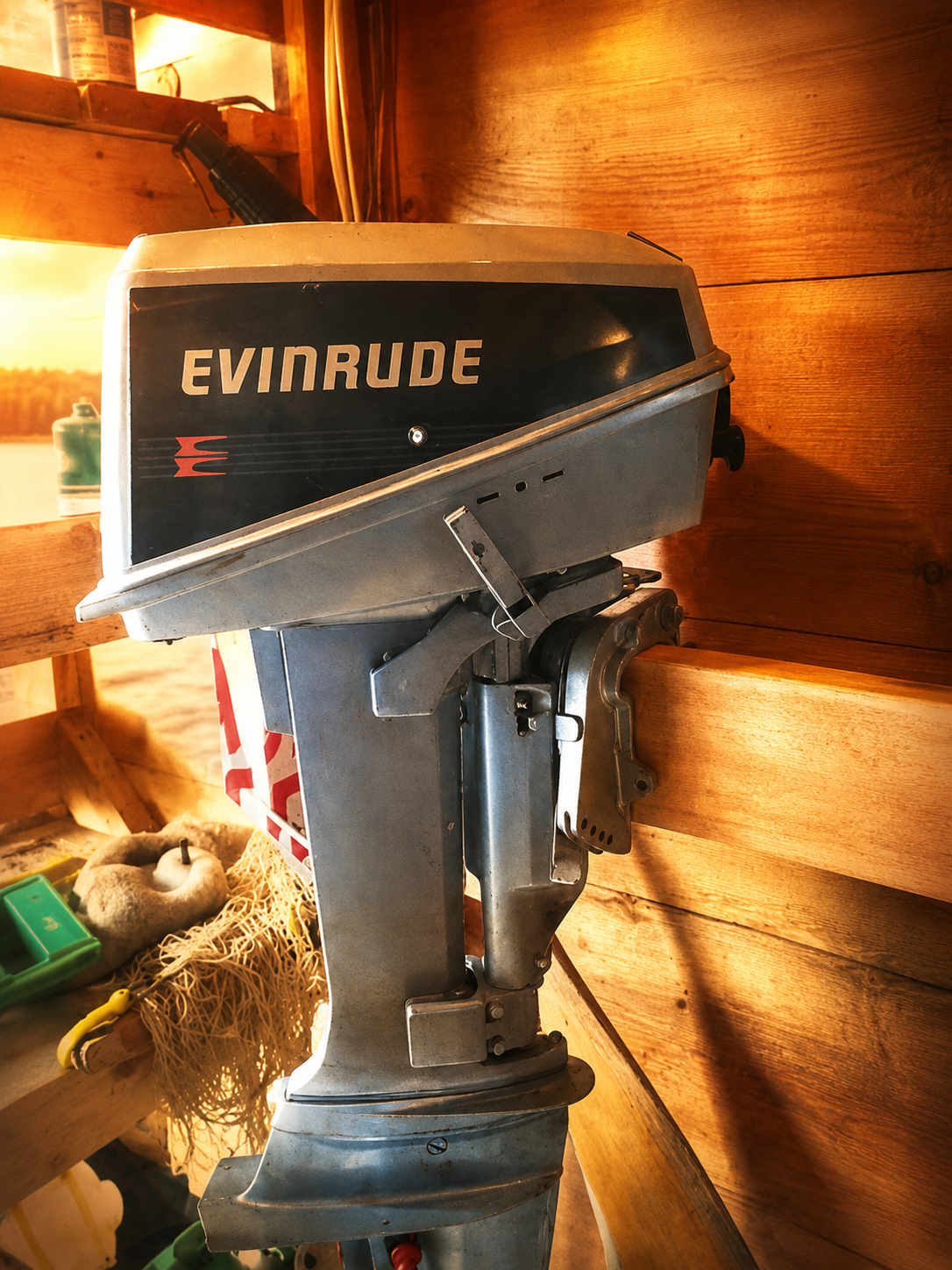
The cabin does not ask me to hurry. The lake does not insist I produce a song or a poem, the ghosts do not ask me to perform, a guest to the cabin is not asked to do anything. Nothing is forced into action except the old Evinrude boat motor.
A dented metal rowboat is waiting near the shore, turned upside down and chained to a tree. It has been there for years, and the stick-on registration numbers are flaking away like peeling paint. It’s as if the boat itself has accepted the slow yet unrelenting gravity of the weather.
I walk 33 steps down the hill to the west, from the cabin to the lake, unlock the chain, turn the boat over, and push it toward the water. Then I lift the old Evinrude from the boat house, trudge it over to the rowboat, and lift it over the mounting board in back.
It is not convenient or pretty. It is physical, concrete, smelly, and hard. That is part of the deal I make here, as most things are that way.
What Can an Old Boat Motor Teach About Attention?
Before music from the guitar, sitar, or dulcimer waiting upstairs with their strings, and before pen put to paper on the table, I want to hear punctuation from that motor.
Every sentence, and therefore every story, begs for an ending, and at the lake by the cabin, punctuation is not a period on a page. It is a cough, a sputter, a blue cloud of exhaust, and the rough voice of an old engine trying to start me or it or anything up.
I attach the gas hose, set the choke, brace my feet, and pull the cord.
Nothing . . .
I pull it again.
And again, many times.
The motor coughs once, a serious protest that carries across the lake. It sounds older than my arm and older than the sitar. I pull again and again until shoulder, elbow, wrist, and hand all enter the sentence where the word pain is part of its construction.
There is no button. No soft electric obedience. No quiet touch of convenience. The motor begins only through effort.
That is why I love it.
How Does Cabin Life Restore Physical Memory?
A manual-start motor is a remedy for a life made easy by buttons and screens. It is a blue beast that insists on the body. It balances my academic life of teaching, grading, writing, and meetings against the ancient work of muscle and breath. It takes me back to a time when life had physical labor, when a person had to meet the world with arm, hand, shoulder, and patience.
Finally, the Evinrude catches. It sputters and shakes, then kicks into idle and coughs out blue smoke near the surface. I remain still for a moment, catching my breath and listening to the end notes of the slowly warming Evinrude.
I hold my breath and cut back the choke, hoping it will not stall. It doesn’t, so I reach for a small lever, pull it forward, and feel the propeller begin to turn as the metal boat slips away from shore.
Handling the motor requires that I reach my left hand across its front and turn the rubber handle clockwise. It is an odd motion, but I bend toward it in an almost ceremonial way. The old motor leans into its task and the lake opens to us both.
Soon I am moving along the south shore of Big Casey Lake, near the lily pads and not far from the bald eagles nesting in a tall jack pine. I cut the engine for a moment and let the boat drift. The glass lake is still and it’s quiet. From the same large, tall pine tree, where eagles have nested for decades, an eaglet screeches for food.
What Is the Role of Place in Lyric Memoir?
This is the elemental pace of life here: water, metal, wood, gasoline, breath, and sound. Boat and body meet the liquid and the solid. The old motor shakes itself awake. The lake opens its long memory. The cabin stands above me in the trees, full of ancestors and their tools, along with music, and stories I’ve not yet written or spoken.
When I push the boat away from shore, the lake invites me into the movement without requiring a destination. That is one of its teachings. Not every journey begins with a plan. Some begin with a rope in the hand, a reluctant engine, and the willingness to keep trying. It’s that way with the red water pump too.
And sometimes the motor does not start.
On those days, I let it be. The lake is patient. The cabin is patient. The instrument’s strings are patient, the stories are patient too, waiting for the touch of my fingers, the labor of attention, and the old sound of punctuation at the end of a sentence
Lyric essays on place, attention, and the natural world. This one, a reflective field-building essay from Stories Emerge Like Bears on cabin life, manual work, memory, and the old Evinrude motor on Big Casey Lake.

What did you notice here? I welcome your thoughts.