WOJB in smoky voice and guitar.
The radio was on in my childhood home, always. A radio keeps songs alive long after they’re hits. I was two years old when Harry Belafonte’s Banana Boat Song climbed the charts, but my hometown station played it for years until it lodged in my mind. Belafonte’s energetic tenor reverberated up the wooden stairs of a small house in North Menomonie, Wisconsin. “Day-O, Day-O, Day-A-A-O.”
As a teen learning drums, the car radio became my portal to other rooms, and my gateway to rock and roll, leading me to mind-blowing world-beats from brothers of other mothers.
Voodoo Child by Hendrix haunted my teens as Day-O became old and decidedly un-hip. Rock ruled, and I tossed Day-O to the wind like a well-worn carpet, exchanging it for a Steppenwolf kind of carpet and ride.
In the 70’s, Ginger Baker and Keith Moon were my gurus and they rattled my brain. I tried copying them, my hands building an iron-grip on my drumsticks like mighty magic wands. I figured if I gripped my Ludwig 5A’s tight enough, and pounded my drums hard enough, my boring Midwestern clothes would burst into technicolor garments, the kind worn by wizards, rock stars, and Jimi Hendrix’s voodoo child in flaming yellow and orange.
When my parents bought a small cabin on a lake in Northwest Wisconsin, I noticed the transistor radio perched on the ledge of a south-facing window for better reception. Almost 50 years now, and it’s still there.
WOJB woodland community radio of the Northwoods, a 2021 Radio Jock’s cant in smoky voice and response in lyric phrase and guitar.
Over the decades, I’ve listened to that radio, waiting for the dawning of a new Day-O, or a wild child and a new song. Living in Ohio, I couldn’t visit the cabin often; but when I did, my first act was to fire up the stove and light up the radio.
By the mid 80’s, I’d established my favorite up-north station on the reliable transistor, and it was 88.9 WOJB. It was, and still is, my favorite station, a Public Broadcasting Channel located on the Lac Courte Oreilles Ojibwe Reserve. Radio humming, I’d turn immediately to WOJB for late-night Old Time Radio Mysteries from the 1930’s. All programming from WOJB appealed to my imagination and vocabulary: The Writers Almanac, Lake Woebegon, Pow Wow Chants in Anishinabe, and other Indigenous languages.
Courtesy of WOJB, Mountain Stage came to me from West Virginia, Thistle, and Shamrock from Celtic Lands, and I’d hear local news, National Native News, Morning Edition, and other National Public Radio programming. I hung my hat in the isolated Northwoods of Wisconsin, but I was connected to the world through radio.
SOUNDS GOOD? You may enjoy more in the link below from “A Northwoods Practice of Stillness, Light, and Listening: When Small is Beautiful.”
I hear the moon lay a path across the ground. I step on it and leave my shadow.
By then I’d learned all rock and roll stations sounded alike with drums resembling subways and screaming guitars broadcasting straight-up rebellion. It did nothing for my imagination.
But WOJB fired my curiosities with their playlists and causes. If I wanted to hear about protests for peace, or long interviews on important topics, information deserving of much more than a 30-second sound bite, I tuned to 88.9 FM.
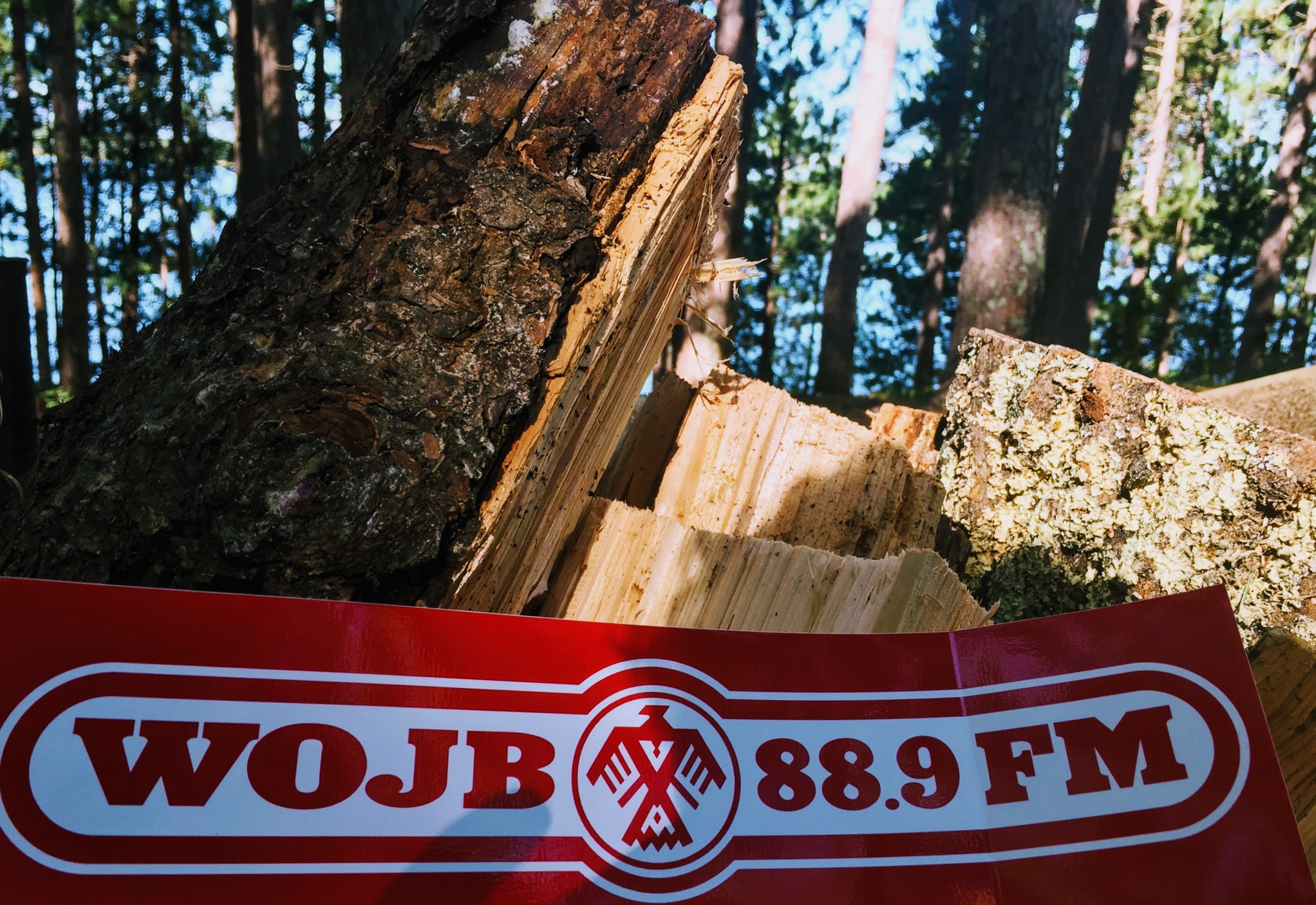
In 2010, I visited the studio with my Irish band, “The Magees,” to play live and to promote an upcoming performance in Northwest Wisconsin. I bought a WOJB sticker there and still have it on my guitar case. My story with WOJB is both remote and local, both personal and impersonal.
It is April 2024, my 40th year of listening to WOJB.
Saga of a love affair with radio goes on
In the Internet age, I listened to WOJB from Hawaii when I lived there, and now I listen in Arizona. Somewhere, now, I get up at 4:30, put on coffee, and find WOJB with radio.net. I want to hear my daughter, Briana because she’s on the mic.

She just started the job as WOJB News Director. Her work day begins earlier than her clock-in time of 5:00 am. There’s a two-hour time difference, so I want to catch her jocking early in the show before some of the Anishinabe words garble her tongue.
She’s on and talking with a guest about wood ticks. Like any non-Indigenous person, she’ll struggle with the Anisinabe words and their pronunciation, even after taking an Anishinabe language class at Northern Michigan University in Marquette. How would we do when black coffee is Muckadaymashkeekiwabu, deer fat is Mushkawujibemiday, and Aaniish Eshnikaazyn asks, What’s your name?
In a few months, I will get up there to visit. It will be too late for the spring arrival of loons (maang), but not too late to catch the latest news about the Lac Court Oreilles Honor the Earth pow wow which I hope to attend.
My connection with WOJB is strong, even more now that Briana is there. Maybe I’ll return to the studio, this time sans drum or guitar, but with happiness for my daughter sitting behind the mic, her clear voice riding the winds, spinning tunes, and reading the news.
I’m glad she’s found a niche in the world of work. In her new world, the language of deer fat is still important and so is the pow wow. It’s a time and place long past, where its natural to redefine faith, thistle, and shamrock. A time and place where misty dawns and wind-frayed cattails are cherished in a soft radio chant.
What did you notice here? I welcome your thoughts.