
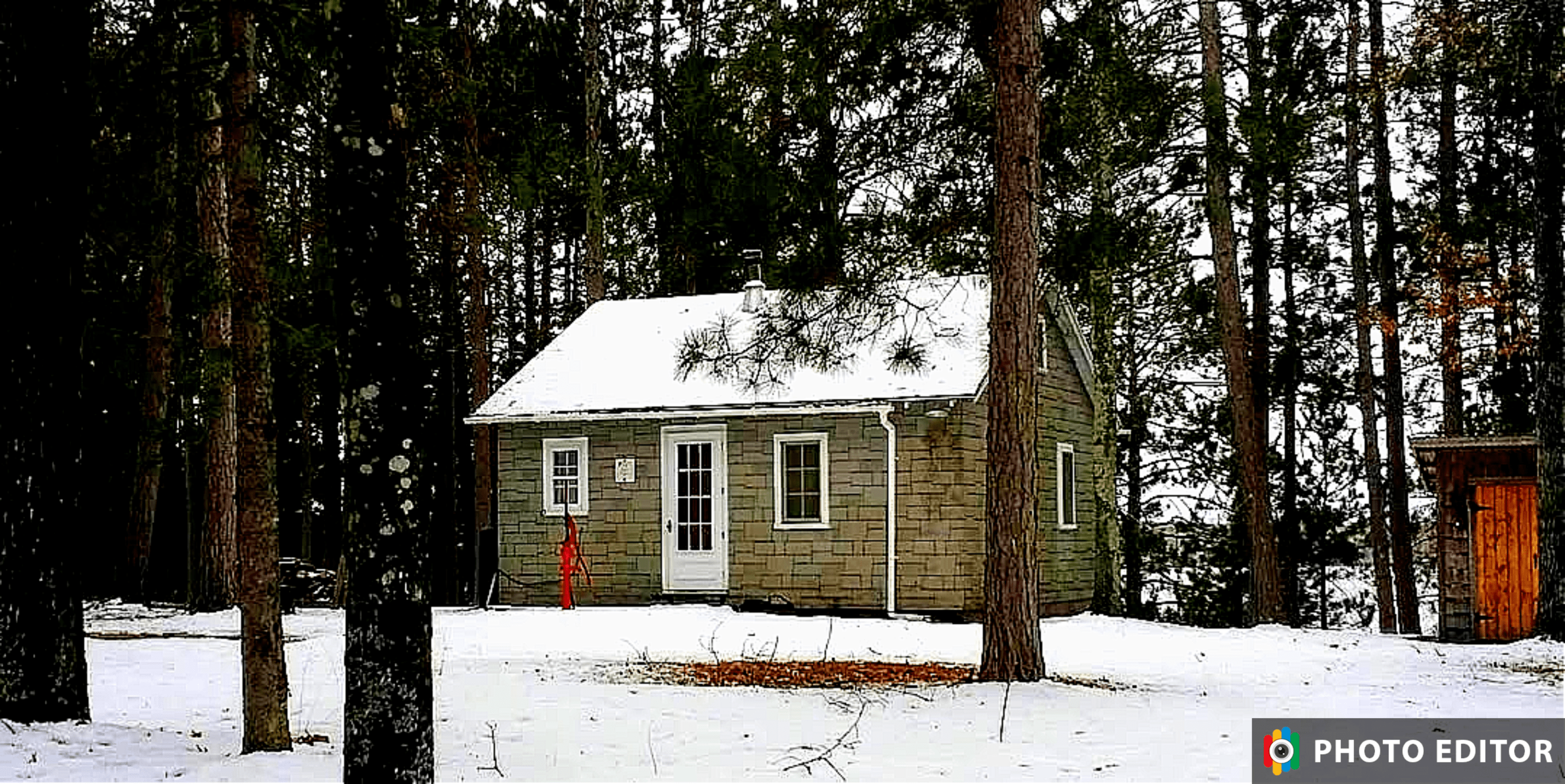
I go to this cabin, not looking for a wizard, but to unmask and absorb what I was taught. I am grateful, and I am surfeit in the company of a crackling fireplace. At night, I sit quietly and listen to reinforce the balance of my soul.
Recalibration begins when I build a fire in the wood stove and pour a dram of whiskey into a glass.
Nobody sees me here, but this is the best that I am, where the small cabin embraces me like a bird in its nest. I am set apart, secure in my cosmic egg, and in a way, it is my second ordination – I’m set down by another office of the keys where my job is to pay attention to everything and damn nothing.
I can keep the volume low on the radio, and a soft, smoky voice says, “Good evening, everyone. It’s Tuesday, and I hope you’re having a good night.” For a moment, the radio that has been sitting in the same place for thirty years goes silent. Then the jock speaks once more to an invisible community. “It’s Tuesday, isn’t it? Wait a minute, let me check. Oh, it’s Thursday. Okay then. I hope you’re having a good Thursday.”
Sometimes the radio’s dead air matches the cabin environment, and it could be any day in history. It is the silence I adore and the way these simple walls put me in this minute. Silence. Then the jock comes back on and speaks in a parsed Ojibwe before going on to another announcement about an upcoming concert at the Park Theatre in Shell Lake.
If language were painted, the WOJB Woodland Community Radio language, from the nearby Lac Courte Oreilles Ojibwe Reservation, would be patina. It lands in my ears as a weathered minimalism, breaking through from another world, like a 1950s era car cast aside and roasting in the desert for seventy-five years, becoming worn and beautiful.
It is just a rustic cabin on a lake, but it sands away the veil of separation and guides me to almanacs of the living and the dead. The trickster is here too, opening glimpses behind the worlds of the living and the non-living. But they pass quickly, wispy rumors of people, shadowy bears and the faint imprints of smell, sound, and touch.
It is spring, and like every other stubborn thing at this place, old man winter is holding on. There is snow on the ground, but it is melting. Fuck you, go away, I tell him. “Fuck you right back,” the old man tells me.
My nose runs.
Darkness comes.
Stars begin sparkling.
I go inside, throw a log on the stove, and begin warming.
Opening the cupboard, I take down a glass. “Heartland of the North Rodeo,” it says. The first rodeo in this area was held in Spooner, just ten miles from this place that refuses to be known quickly. It happened a long time ago, in the year I was born.
Carl Jung called synchronicity the acausal connecting principle between two seemingly unconnected events but with surprising coincidence and power. I pour a dram of whiskey into the basement of the rodeo glass, the sound echoes eerily in my ear as the splash of a spooky synchronicity; I hear the water of my infant baptism on Halloween Day in 1954, a couple months after that first Heartland’s Rodeo.
Sublime hauntings of sound are familiar to me. I recall listening to a mesmerizing recording of the Kauaʻi ʻoʻo’s call, a bird once living on Kauaʻi in the Hawaiian Islands. It’s now extinct. I imagine hearing them back when the rodeo started, their sweet ʻoʻo reverberating up and down the Waimea Canyon on Kauaʻi’s west side.
A lover of birds, Henry David Thoreau once characterized the bobolink’s call as being “like liquid bubbles from trembling strings.” Liquid bubbles, trembling strings, an extinct bird’s two-note ʻoʻo, whale and dolphin squeal. I know it all. I also know the alluring sound when a bass breaks the surface to lip a fly and take it to its watery domain, and the splash of whiskey echoing over ice in the bottom of a baptismal font or rodeo glass.
A loon calls again, taking me back to memories that run deep here. Back to people and ashes. Back to the bear, owl, and eagle. Back to the many glassy-eyed fish we have caught, flayed, fried, and eaten.
Tonight, the loon call is a sharp-edged yodel, a strong haunting from the lake to my fish table. Its call paints the sound of pain in a tremolo, like a shaking rodeo bull rider mounting a snarling beast before kissing the patina-colored dust.
Quiet, please.
I hear the fish frying, softly now, in oil.
The skillet is dusted with flour. I plop a dash of salt and pepper. Simple minerals. Seasonings. Nothing fancy. Everything slowly learned and known; the smell of memory raised from the steps and chants of another time.
The chairs are hard. There are no soft sofas. I accept this and hope my biological requirements will not distract me from my intent, learning how to be present. For as much as possible, I am positioned to succeed in my mission. I am going without an agenda and nothing to do. I have food and time, and no one is riding my ass from behind, as they do on the Phoenix interstates.
“I ams what I ams,” Popeye would say, and this is enough.
Now it’s night and dark. The owl haunts with its question, who are you? A bear rustles in the bushes, then away. I offer all that I am at this altar of the known and unknown. Mitakuye oyasin.
We are all related.
#LyricEssay
#CreativeNonfiction
#LiteraryNonfiction
#PersonalEssay
#placebasedwriting


 GREGORY ORMSON'S Notes, Articles, Blogs, Vlogs Gregory Ormson writes from the ecotone, the vibrant intersections of landscape, spirituality, and physical presence. His essays and poems have appeared in literary journals, anthologies, and print magazines. Author of *Yoga Song* and other works, Ormson blends lyrical observation with grounded reflection drawn from his Midwestern roots and global travels. He lives in Arizona and Wisconsin, seeking stillness where stories emerge like bears.
Leave a comment